
Pricing and Promo Decisions in the Age of AI
A 30-minute live session for FMCG pricing, RGM and category leaders on testing pricing and promotion decisions before you make them, not guessing at them.
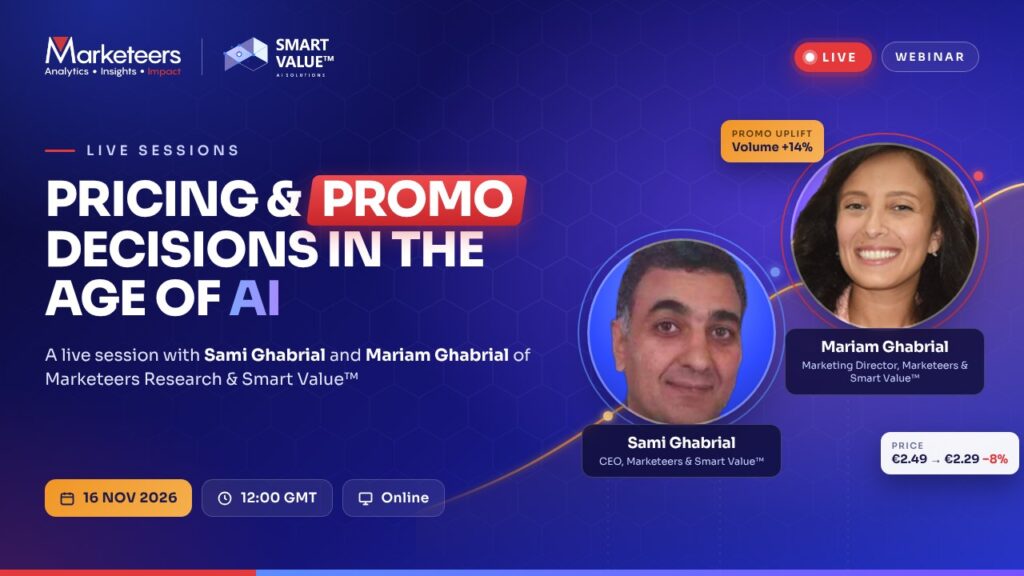
Missed the live session? This recording covers pricing and promo decisions from both sides of the table: what the brand pays for a promotion, what the retailer gets from it, and how to test the call before the money is spent.
Watch the recording
The full 30-minute session on pricing and promo decisions, including the live Q&A. Watch it here or share the page with your team.
About this session
Every one of your pricing and promo decisions is a bet: on margin, on share, on the retailer relationship. Most teams make that bet with good instincts and incomplete information, under more pressure than ever to get it right the first time.
In this 30-minute session, Sami Ghabrial, CEO of Marketeers Research, and Mariam Ghabrial, Marketing & PR Director at Smart Value™ AI Solutions, walk through what pricing and promo decisions look like when they are tested before you make them, not guessed at.
Key takeaways on pricing and promo decisions
- Start with the goal, not the mechanic. Good pricing and promo decisions start by deciding whether the promotion is for volume, revenue or margin, then pick the route, the SKU and only then the mechanic.
- The uplift in the sales report is not the return. Part of the spike was taken from your own packs, part was bought early, and part would have sold anyway at full price.
- Every SKU plays a different role. The same discount can win new buyers on one pack size and cannibalise a bigger, more profitable size on another.
- Many promotions end with a negative ROI, and most teams never see it because they only look at the total against target.
- AI does the arithmetic. Your team makes the call. The point of a platform is stronger decisions, not handing the decision over.
Why pricing and promo decisions that look like a win still lose money
Mariam opened with a moment most brand and category teams know well. The retailer pushes a promotion because it brings traffic to the store. The numbers go up and everyone is happy. Then you look closer and find you have lost money.
Promotions are not going away. Research from NielsenIQ and McKinsey that she referenced still shows around one in four FMCG units sold on promotion, across markets such as the Nordics, Germany and the UK, with promo pressure rising year on year. At the same time, negotiations between brands and grocers are getting harder and often come down to price alone. A fight over margin leaves both sides with less.
The session then broke down a typical promo week. Volume spikes, but only a small share of it is genuinely new to the brand. The rest comes from your own packs, from shoppers who stocked up early, or from sales you would have made anyway. After the promotion, shoppers have the product at home and the following weeks dip.
Inside the retailer’s room, the picture is just as uncomfortable. The brand paid for the discount and its margin dropped. The retailer’s shoppers stocked up, so they visit less often and the store loses traffic, which is the opposite of what the promotion was meant to do. Good pricing and promo decisions look past the promo week to what happens to the whole category afterwards.
Emma’s quarter: pricing and promo decisions from goal to mechanic
To make it concrete, the session followed Emma, a persona built from years of client work. She is a commercial manager at a beverage brand with a retailer review in six weeks and next quarter’s promotion plan to bring.
- Three brands competing in her category.
- Six Excel workbooks that record what happened last year but cannot tell her what will happen next.
- One fixed trade budget, where every pound has to count.
The temptation is to jump straight to the mechanic: a multi-buy, a discount, something extra for free. Emma starts instead with the goal. Is this quarter about volume, revenue or margin? Once that is clear, she picks the route. For her, the data pointed to upsizing, moving shoppers to the bigger pack. Only then does she choose the SKU and the mechanic, not the other way around.
What each SKU really does for you
Sami has worked on predictive modelling, pricing and promotions since the early 2000s, and on revenue growth management for the last five years. He shared two things that come up in almost every analysis: most promotions chase volume, and most teams know the uplift of a promotion but not its return. They cannot say where the extra volume came from, or what they earned on the biggest investments behind it, such as displays, flyers and in-store media. That gap is where pricing and promo decisions go wrong.
The approach starts with the consumer. How do shoppers perceive each SKU? How price sensitive is it? At what price do they switch, and do they switch to another pack of yours or to a competitor? Answering that tells you which SKUs bring profit, which bring volume and which bring new buyers.
His example: the same discount on a 250 ml pack recruited new buyers from competitors and delivered a healthy volume uplift. On the 330 ml pack, most of the uplift was cannibalisation, much of it taken from the brand’s own larger 500 ml bottle. Without looking at each SKU, a team can walk into that trap without meaning to.
Four questions to ask before any pricing and promo decisions
- Will each promotion pay back? Not the uplift, the return after trade spend and in-store costs.
- What does each lever earn? The discount, the display, the flyer and every other in-store investment, and how that return changes by SKU.
- Where does the volume come from? From the competition, or from yourself, and if it is from yourself, does that help you or hurt you?
- What if the competitor moves? A forecasting model lets you run what-if scenarios, respond quickly and have a plan B ready.
From discount pressure to a conversation both sides win
Every promotion has to be judged on three things: the impact on the brand, on the manufacturer’s category and on the retailer’s category. If one side loses, the promotion does not work for long.
Sami’s point was that whatever promo planning platform you use, it should back your pricing and promo decisions with enough evidence to bring the retailer real alternatives. That turns the negotiation from pressure to discount into a conversation where both sides win. Each slot in the calendar gets a job agreed with marketing, such as trading shoppers up to a bigger size, pushing premiumisation or growing penetration. The recommended plan is then forecast across the whole quarter and checked against the annual targets, so no promotion is judged in isolation.
In the session, Sami also showed the Promotion Planner live: planning, the execution calendar, negotiation and approvals with retailers, performance monitoring, what-if analysis, competitor moves and cannibalisation in one place, so the whole team makes pricing and promo decisions from the same numbers.
Where AI helps and where your team makes the call
One question comes up in almost every conversation: is AI going to take over these decisions? The answer in the session was no. AI does the arithmetic. Your team makes the call. The value of a platform is helping your team make stronger pricing and promo decisions that show up in ROI, with the judgment staying where it belongs.
The promo decision health check
Mariam closed with a short self-check to take back to your team. It scores how your team makes pricing and promo decisions today: setting one objective per promotion, testing price moves, measuring true ROI and test-and-learn, from not at all to fully in place.
- Starting out (0 to 5): the foundations are still going in. Most of the work lives in Excel and takes a lot of time, even where AI is used to summarise it.
- Building: you start predicting the outcome of a promotion before you commit to it.
- Leading: where many top multinationals sit. The whole promo calendar is optimised, with pack rules applied and weekly forecasts tracked monthly against the plan.
Where you score tells you the right next step for your pricing and promo decisions. Watch the last part of the recording for the full health check.
Questions from the live Q&A
Tools like Claude and ChatGPT are moving fast. What does a promo planner add?
General AI assistants are good at conversation and suggestions, and an individual can test a lot with them. A company needs something different: a platform that makes pricing and promo decisions part of how the business works. Building one takes finance, marketing and sales on the business side, plus data scientists, AI specialists and a development team to put it into production and keep it running.
How do you work with consultants?
Consultants in revenue growth management and market research usually come to add an AI tool to the services they already offer. They build or refine the strategy for their clients, and the clients get more measurable improvements and lasting in-house capability. More on that on the Partner with us page.
Is it a SaaS product with a monthly subscription?
Yes, it runs on a monthly subscription, but it is adapted to each client and category, because every category behaves differently. It takes about a week to understand the category from the data, and the platform is ready within one to two weeks at most.
Test your own pricing and promo decisions
If you are a manufacturer, consultant or agency, a short conversation is enough to start. Tell us how your team plans promotions today and we will build a demo around your category within a few days. See Smart Value™ in action.
Mariam also hosts Human in the Loop, the interview series on where AI decision-making ends and human judgment begins.
You’ll leave knowing
- Where a pricing move that looks safe on share can quietly cost margin and how to catch that before it ships, not after.
- Why a promo that wins on volume and one that actually wins on ROI get confused more often than most teams admit and what separates them.
- A working line between what AI should decide and what only your team can call, one you can defend internally, not just take on a vendor’s word.
Built for FMCG pricing, RGM and category leaders.
Your hosts

Sami Ghabrial
CEO, Marketeers ResearchLeads Marketeers Research, which has spent 30 years on FMCG category, pricing and shopper research.
LinkedIn
Mariam Ghabrial
Marketing & PR Director, Smart Value™ AI SolutionsLeads marketing and PR for Smart Value™ AI Solutions and hosts Human in the Loop, the interview series on where AI decision-making ends and human judgment begins.
LinkedInMore live sessions
See what is coming up next.