

Pricing and promotion decisions in the age of AI usually start with the same pitch to every FMCG pricing committee: plug in an AI engine, let it set the prices, and watch margin improve on its own. It is an attractive promise for a team that spends half of every quarter reconciling spreadsheets. It is also the wrong question.
The question executives should be asking is not “can a model set our prices?” but “can a model show us the consequences of a price decision before we make it, inside limits we control?” That is the difference between handing pricing to an algorithm and using decision intelligence.
What changes for pricing and promotion decisions in the age of AI?
AI makes pricing and promotion decisions faster and better evidenced. It joins sell-out, trade spend and competitor data, tests price and promotion scenarios before launch, and flags any move that breaks an agreed limit. What should not change is who decides: leadership sets the guardrails, AI works inside them, and exceptions come back to a person.
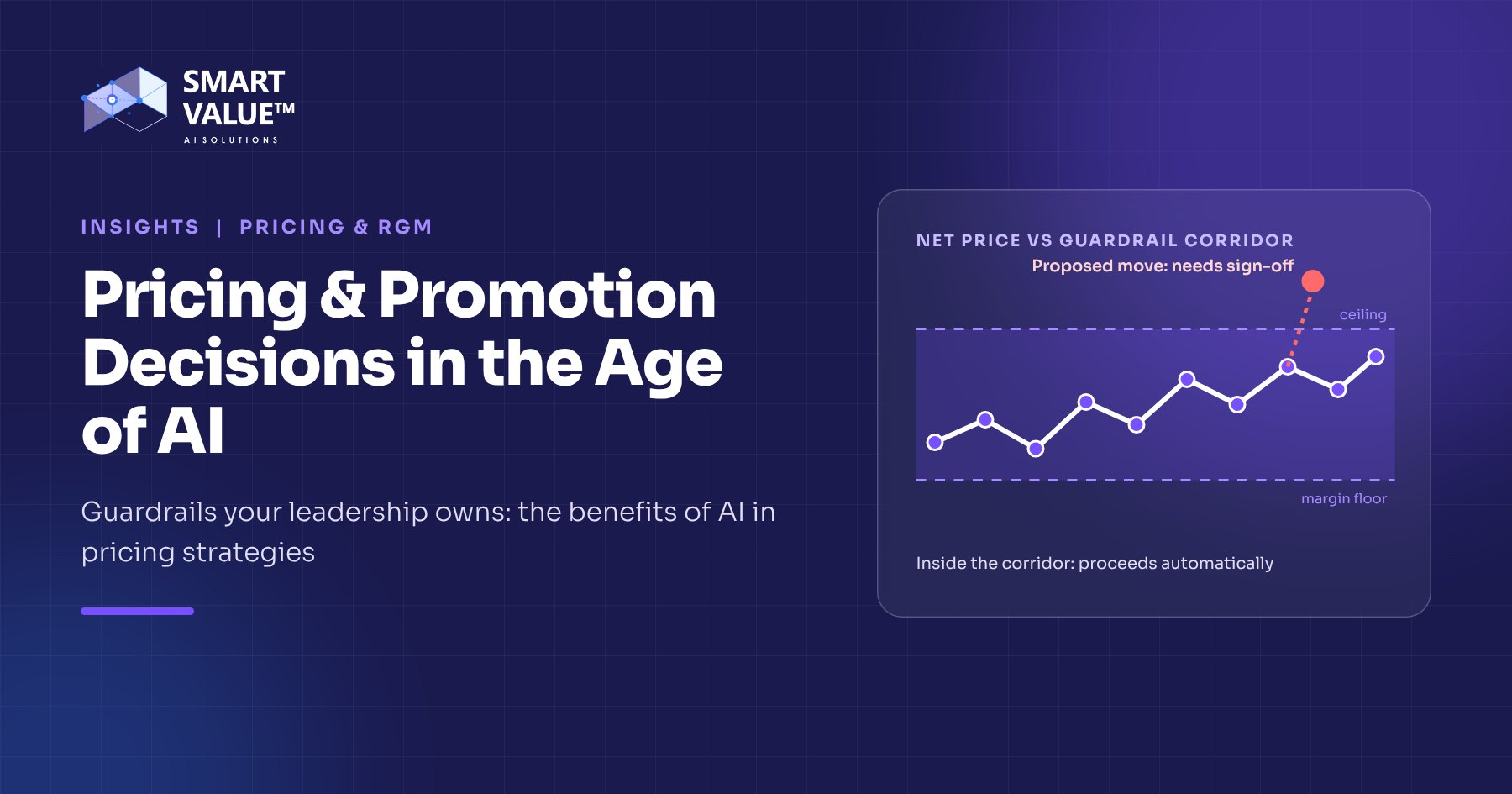
Executive briefing: pricing and promotion decisions in the age of AI
- The problem is not a lack of data. Retail sell-out, internal shipments and trade spend, and competitor and shopper data all exist. They simply never meet in one place at the same level of detail. More data does not fix that, better data-driven decision making does.
- Fully automated pricing optimises what it is told to optimise. It does not know your retailer agreements, your brand ladder, or which markets treat staple prices as a political issue.
- Decision intelligence keeps the judgement with leadership. The model converges the data and runs the scenarios. Executives set the guardrails, and anything outside them comes back for sign-off.
- The upside is large and measurable. McKinsey’s December 2024 research on revenue growth management found that companies that excel could achieve as much as 1.2 to 1.5 times net-price realisation above baseline inflation.
In this article
The executive pricing dilemma: three data sources that never meet
Ask a commercial director why last quarter’s price increase delivered less than planned and the answer usually arrives in three different files, from three different teams, at three different levels of detail.
- Retail sell-out data shows what shoppers actually bought, by store, week and SKU. It usually sits with insights or category management.
- Internal sell-in, cost and trade spend shows what was shipped, at what invoice price, and what was paid back to the retailer in discounts, rebates and deductions. It sits with finance and sales.
- Competitor and shopper data shows the price gaps on shelf and how consumers trade between brands and pack sizes. It sits with marketing or comes from a research agency.
Each source is accurate on its own. The trouble is that a price decision touches all three at once. A list-price increase on a 1L pack changes the shelf price gap to the competitor, shifts some shoppers to your own 500ml pack, and changes what the retailer expects back in promotional funding. When the three datasets live apart, the executive is left to stitch the story together in a meeting, usually with whichever number the loudest function brought.
The cost of that fragmentation shows up in time. In McKinsey’s October 2026 survey of senior commercial leaders in consumer goods, more than half said drafting a customer plan takes over five days, and nearly all said end-to-end approval cycles take more than three weeks.
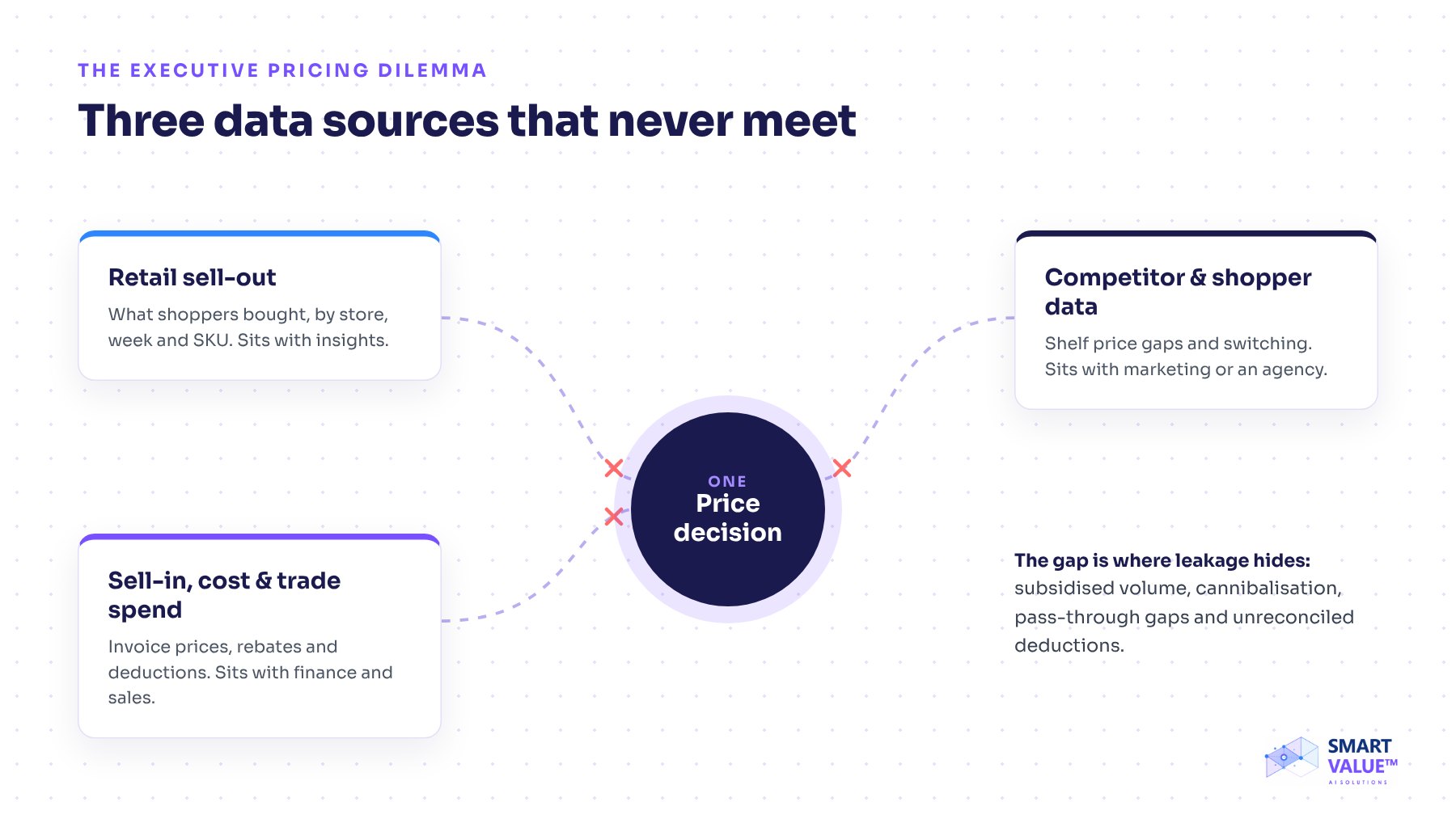
Where promotional leakage usually hides
Trade promotion is one of the largest investments on an FMCG profit and loss after cost of goods, and it is where disconnected data costs the most. The leakage rarely shows up as a single bad event. It hides in the gaps between datasets:
- Subsidised loyal volume. Discounts paid to shoppers who would have bought at full price anyway.
- Self-cannibalisation. The promoted SKU grows, but mostly by taking volume from your own adjacent packs.
- Forward buying and post-promotion dips. Retailers and shoppers stock up during the deal, then buy less for weeks afterwards.
- Pass-through gaps. Funding paid to the retailer that never fully reaches the shelf price.
- Unreconciled deductions. Claims settled in finance months later, long after anyone evaluated whether the event worked.
None of these is visible in sell-out data alone, or in trade spend data alone. They only appear when the two are joined at the same SKU, customer and week.
Agentic AI in pricing: what AI can run, and what stays with leadership
The question for executives in 2026 is no longer whether to use AI in pricing. It is how far to let AI agents act on their own. Agentic AI is AI that can carry out multi-step work by itself: gather the data, run the scenario and, if it is allowed to, execute the decision.
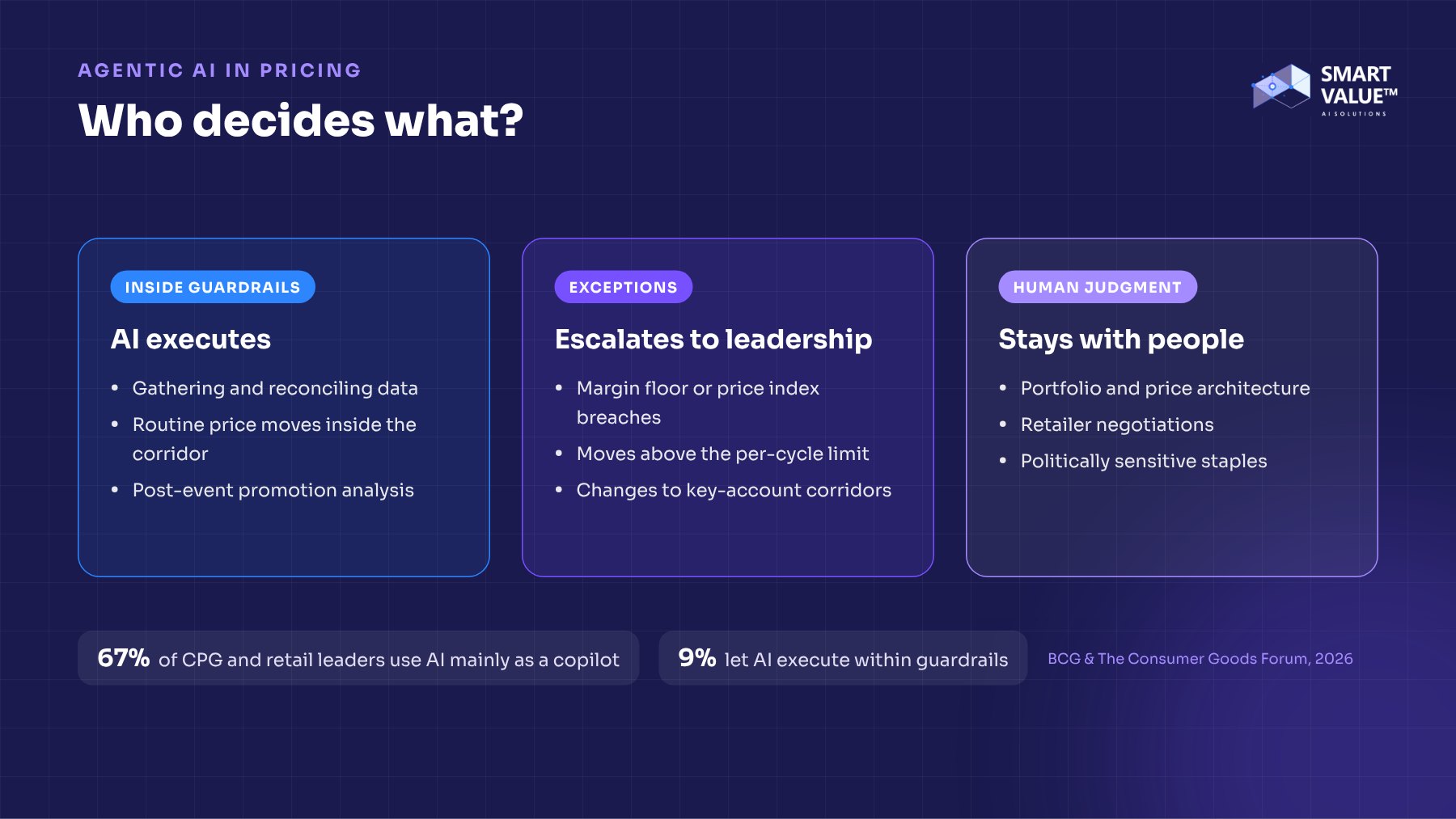
Most consumer goods companies are drawing that line carefully. In a 2026 board brief from BCG and The Consumer Goods Forum, 67% of CPG and retail executives said they still use AI mainly as a copilot, where AI generates insights and humans make the final call. Only 9% let AI execute decisions within guardrails while people manage the exceptions.
Where AI agents earn their place
McKinsey’s October 2026 research ranks data gathering, pricing and margin management, and promotion planning among the activities where AI agents offer the strongest mix of time savings and better quality. In practice that means:
- Reconciling the data every week. Sell-out, shipments, trade spend and competitor prices joined without days of analyst time.
- Running the scenarios before the meeting. Hundreds of price, pack and promotion options tested before anyone argues about one.
- Reviewing every promotion. Post-event analysis for the whole calendar, not only the biggest events.
- Flagging the exceptions. Any proposed move that breaches a guardrail goes to a named person with the reason attached.
Three commercial risks to keep under human control
- Damaged retailer relationships. An agent that moves net prices outside the corridors agreed with a key account, or recommends a promotion one retailer sees as favouring another, creates a negotiation problem no elasticity curve accounts for.
- A broken price architecture. Optimising each SKU in isolation can push a premium variant below the mainstream one, or close the gap between pack sizes until the larger pack no longer looks like better value. The brand ladder took years to build and can be flattened in a few cycles.
- Regulatory and reputational exposure. In many MENA and GCC markets, staple prices are monitored closely and sudden moves attract attention. A recommendation nobody can explain is hard to defend to a regulator, a retailer or your own board, and the human oversight provisions of the EU AI Act point the same way.
The risk is not theoretical. In December 2025, a Consumer Reports and Groundwork Collaborative study of more than 400 shoppers in four US cities found Instacart’s AI-driven price tests showing as many as five different prices for the same item, in the same store, on the same day. Instacart ended the tests within days, saying they had “missed the mark for some customers.”
The lesson is not to avoid AI agents. It is to decide in advance which decisions they can execute, which exceptions escalate, and where human judgment stays.
How decision support for pricing works: data convergence plus human guardrails
The category has matured quickly. In January 2026 Gartner published its first Magic Quadrant for decision intelligence platforms, which it describes as combining decision modelling, analytics and AI to augment and automate decision making. Applied to pricing and promotion decisions in the age of AI, that becomes three layers.
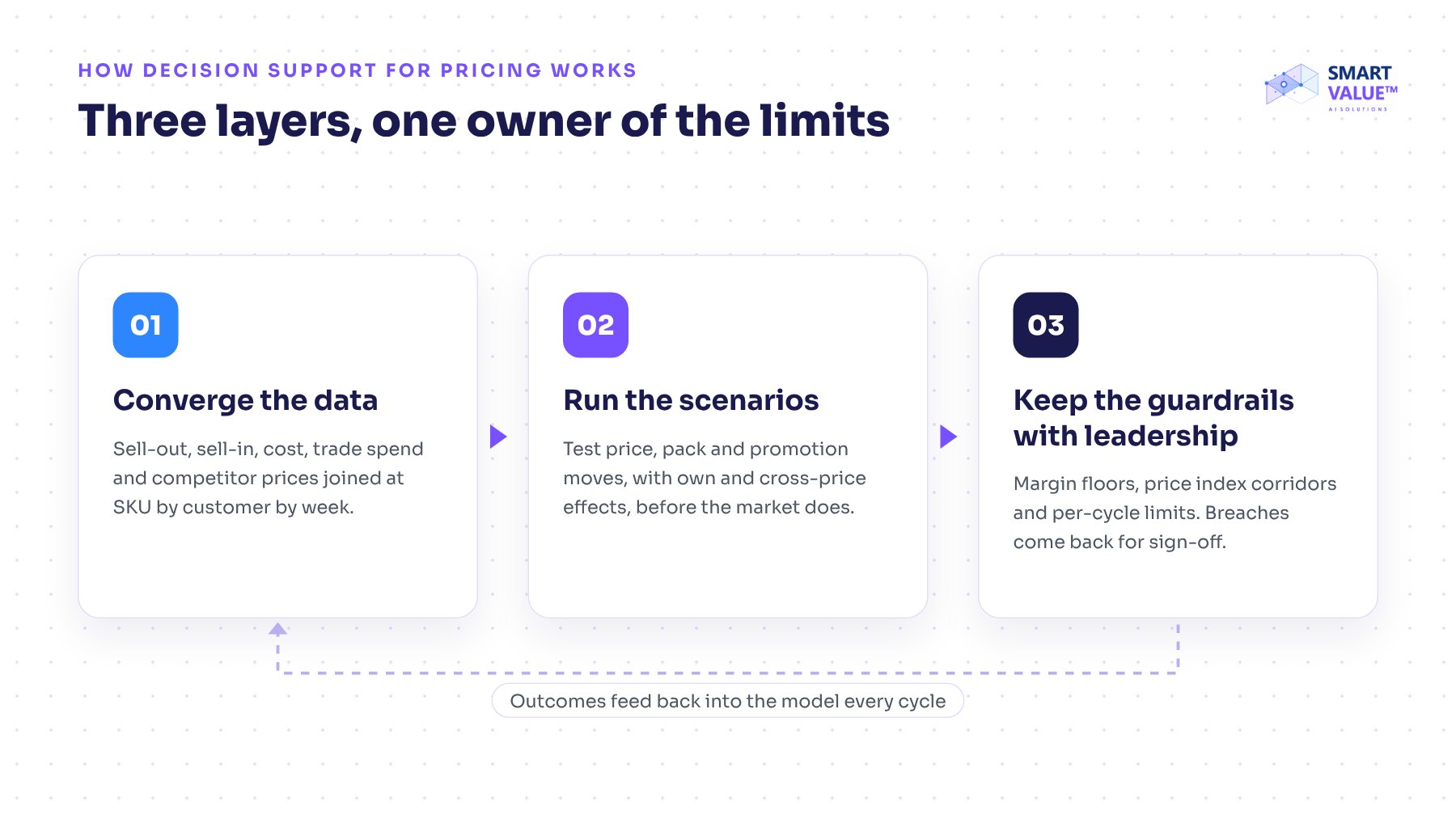
Layer 1: Converge the data
Sell-out, sell-in, cost, trade spend and competitor prices are joined into one model at a common grain, typically SKU by customer by week. This is unglamorous work, and it is where most of the value starts. Once the datasets agree, promotional leakage becomes measurable and every later conversation uses the same numbers.
Layer 2: Run the scenarios before the market does
With the data converged, the model estimates how volume responds to price, including cross-price effects between your own SKUs and against competitors. The team can then test a decision before committing it: a 4% increase on the 1L pack with the 500ml held, a shallower but longer promotion, a pack-price change instead of a list-price change. Each scenario returns its expected effect on volume, revenue, margin and share, and the assumptions behind it.
Layer 3: Keep leadership in charge of the guardrails
This is the layer that full automation leaves out. Leadership sets the limits once, and the model optimises within them:
- Margin floors by brand, SKU or channel.
- Price index corridors against named competitors.
- Maximum change per cycle, so shoppers and retailers never see a shock.
- Price ladder rules that keep premium above mainstream and larger packs better value per unit.
- Promotion depth and frequency caps by customer.
McKinsey’s October 2026 research on agentic AI in consumer goods describes the same split: AI handles the busywork while people make the judgment calls, and leaders set guardrails so the system can act without a full reapproval cycle. Recommendations inside the guardrails can move quickly. Anything that breaches one is routed back to a named person for sign-off, with the reason attached. Try it below with a simple three-guardrail setup.
Quantifiable enterprise impact: the benefits of AI in pricing strategies
The benefits of AI in pricing strategies are easiest to see in recent evidence from the companies and analysts closest to the problem.
- Price realisation beats inflation. McKinsey’s December 2024 analysis found that companies that excel at revenue growth management could see as much as 1.2 to 1.5 times net-price realisation above baseline inflation, while still growing consumption in line with their categories.
- The prize is measured in basis points. A 2026 board brief from BCG and The Consumer Goods Forum estimates that scaling AI across the demand value chain can deliver 220 to 350 basis points of cumulative EBIT for CPG companies, with revenue growth management among the first areas to move.
- Leaders are already doing it, with people in charge. Reckitt has rolled out AI-enabled revenue growth management platforms across 35 markets since 2021. McKinsey reports higher category gross profits and stronger promotion ROI, with leaders testing what-if scenarios before implementation.
- Most companies are still early. In McKinsey’s 2026 survey of 41 senior commercial leaders in consumer goods, only 12 had embedded AI into core workflows or scaled it across their organisations.
For pricing and promotion decisions in the age of AI, none of these benefits requires handing pricing over to an algorithm. All of them need converged data and a disciplined way to test decisions before they reach the shelf.
A worked example
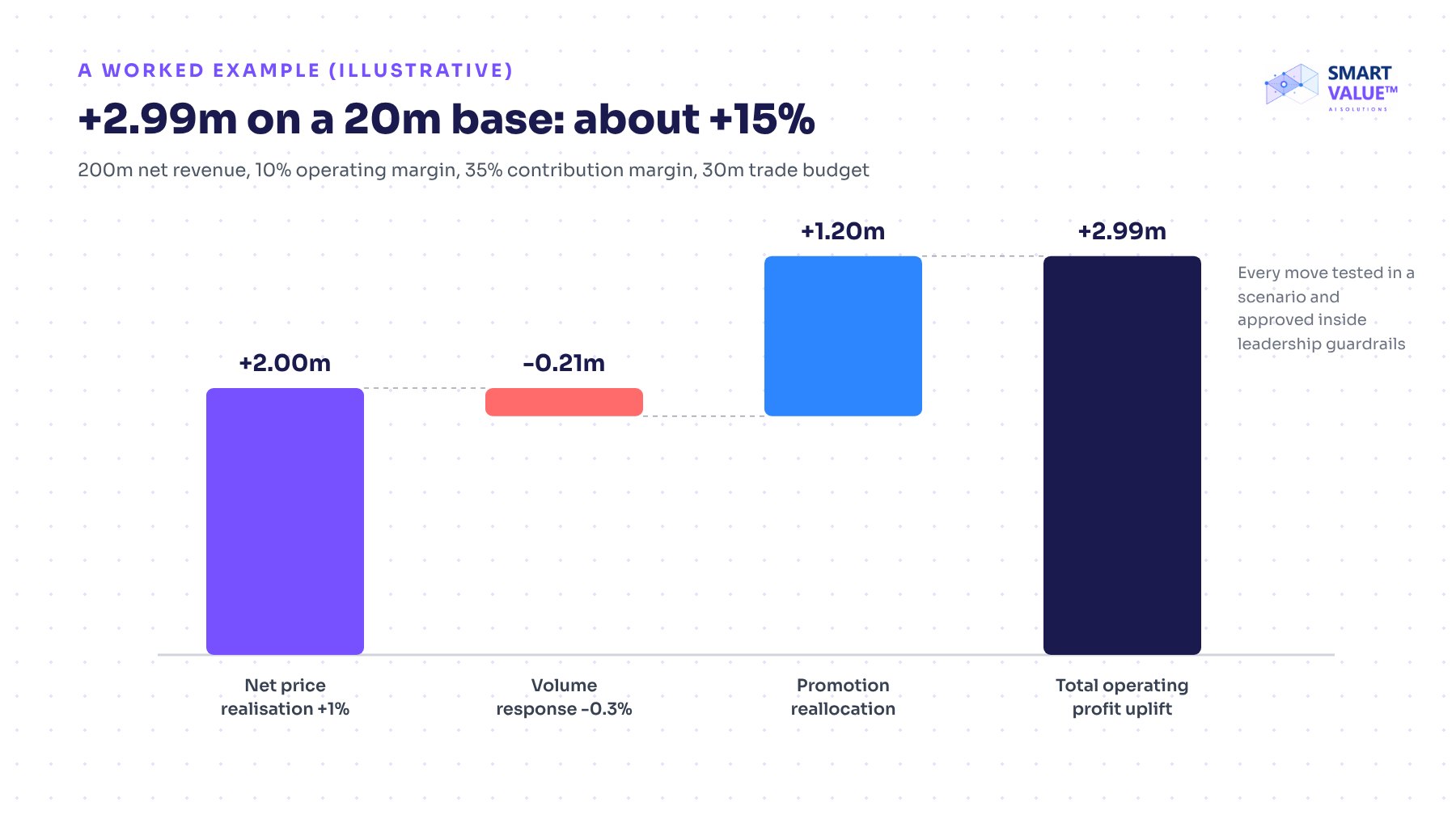
Take an illustrative FMCG manufacturer with 200 million in annual net revenue, an operating margin of 10% (20 million operating profit), a contribution margin of 35%, and a 30 million trade promotion budget. Leadership approves a guardrailed pricing round and a promotion review.
| Lever | Assumption | Operating profit impact |
| Net price realisation | +1.0% average, inside all guardrails | +2.00m |
| Volume response | -0.3% volume at 35% contribution margin | -0.21m |
| Promotion reallocation | 3m moved from events returning 0.70 per 1 spent to events returning 1.10 | +1.20m |
| Total | +2.99m (about +15% on 20m) |
The figures are illustrative, but the shape is typical. A one-point price move and a tenth of the promotion budget redirected add around 15% to operating profit, and every decision behind that number was tested in a scenario and approved within limits leadership set in advance.
Frequently asked questions
What is decision intelligence for pricing?
It is an approach that joins pricing, promotion, cost and market data into one model, uses that model to simulate the outcome of price decisions before they are made, and keeps final authority with people through guardrails that leadership sets. The aim is better decisions, not automated ones.
What are the benefits of AI in pricing strategies?
Used with guardrails, AI makes elasticity and cross-price effects measurable across the whole range, tests price and promotion scenarios before they reach the shelf, exposes promotions that do not pay back, and frees the pricing team from reconciling spreadsheets so it can spend its time on judgement.
How is decision intelligence different from an AI pricing engine?
A typical AI pricing engine is built to set prices automatically. Decision intelligence is built to support the people who set prices. It shows the trade-offs and assumptions behind each recommendation, and anything outside agreed limits comes back for human sign-off.
Can AI agents set prices on their own?
They can, but few consumer goods companies let them yet. In a 2026 BCG and Consumer Goods Forum survey, only 9% of CPG and retail executives let AI execute decisions within guardrails. The safer model lets agents handle routine moves inside agreed limits and sends anything outside them to leadership.
What guardrails should an FMCG pricing team set first?
Start with four: a margin floor by brand or SKU, a price index corridor against your main competitors, a maximum price change per cycle, and price ladder rules between tiers and pack sizes. Promotion depth and frequency caps by customer are a sensible fifth.
What data do we need to get started?
Retail sell-out data, internal shipments with invoice prices, trade spend by event, unit costs, and competitor shelf prices. Most FMCG manufacturers already buy or hold all of these. The work is joining them at the same level of detail, usually SKU by customer by week.
How quickly does decision support for pricing show results?
Promotional leakage is often visible as soon as the data is converged, because events that did not pay back become measurable for the first time. Price realisation benefits typically follow over the next one or two pricing cycles as scenarios replace spreadsheet debates.
Evaluating your enterprise pricing architecture?
Getting pricing and promotion decisions in the age of AI right is less about the algorithm than the architecture around it. If your pricing decisions still depend on three teams reconciling three datasets the week before a retailer meeting, the first step is not a new algorithm. It is one view of the data, scenarios you can test, and guardrails your leadership owns.
See your own guardrails at work
Smart Value converges your sell-out, trade spend and competitor data, runs the price and promotion scenarios, and keeps every recommendation inside the limits your leadership sets.
Book a pricing architecture review →Sources
- McKinsey & Company (October 2026). For CPG companies, agentic AI’s real payoff is growth.
- BCG and The Consumer Goods Forum (2026). AI in CPG and Retail: How Winners Are Pulling Ahead (board brief).
- McKinsey & Company (January 2026). Reckitt’s bold ambition: harnessing AI to redefine revenue growth management.
- Gartner (January 2026). Magic Quadrant for Decision Intelligence Platforms.
- ConsumerAffairs (December 2025). Instacart ends AI price testing after watchdog report.
- McKinsey & Company (December 2024). Harnessing revenue growth management for sustainable success.
- European Union (2024). EU AI Act, Article 14: Human oversight.